Dan Bater
Current Employer/Organisation Name
BBC
What have you been doing since leaving Exeter, and what are you doing now?
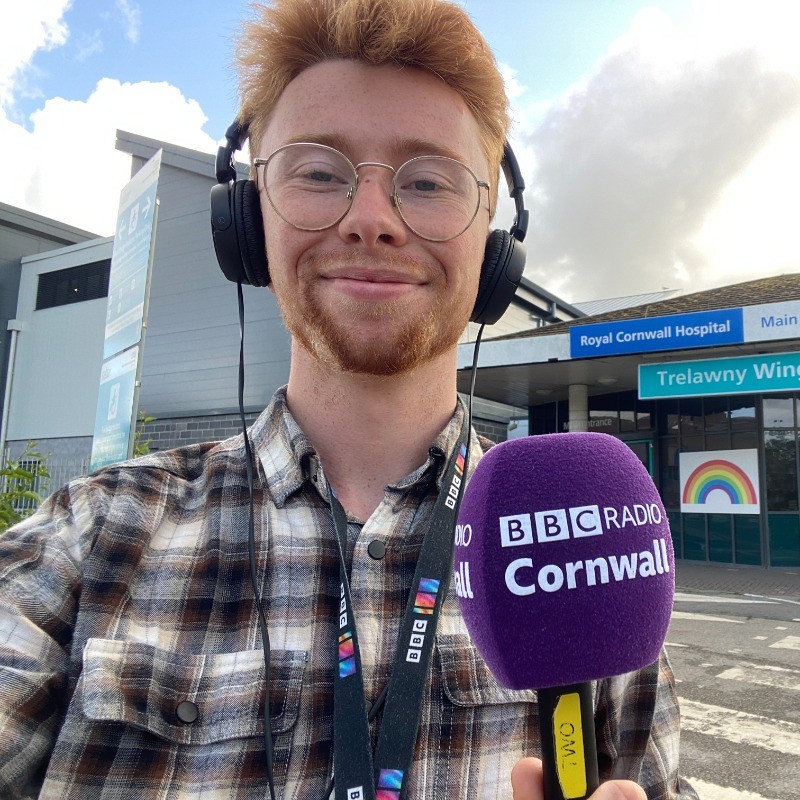
After working for a brief time as an SEN tutor, I was accepted onto the BBC Production Apprenticeship Scheme. It was 18 months of working hands-on in a variety of roles at BBC Cornwall alongside gold standard media industry training. Once I graduated from the scheme, I kept working at BBC Cornwall as a producer and journalist; initially on fixed-term contracts before getting a permanent position there near the end of 2023. This position involved a wide range of roles, from producing live radio programmes to being an out-and-about reporter for all platforms (TV, social media, the BBC website and radio) in addition to content creation for social media.
At the start of 2025, I started an attachment at BBC Yorkshire as a multi-media journalist, which finishes in April 2026. It has been fascinating seeing how another region operates with a very different set of stories entering the newsroom and I have loved being able to focus more on video editing, TV packages and website articles. I enjoy being relied upon to deliver stories via social listening techniques and generate content which serves each team and format.
In the last few years, I have managed to get lots of my self-produced stories onto the national BBC News channel, BBC Breakfast, the official BBC News TikTok, BBC News UK Instagram, BBC Sport socials as well as other international and national channels. Each time a story I have crafted gets that sort of exposure, I have to pinch myself as it truly is a dream come true.
Why did you choose this career? And what do you enjoy most about your work?
Although the BBC Production Apprenticeship scheme was an educational ‘level’ below my university degree, the media modules on my course and extra-curricular activities of student radio, visual podcasting and livestreaming ignited a passion for media production that I just could not ignore. The BBC was a company I’ve been interested in working for in some capacity since I was very young and when this opportunity to get my foot in the door arose, I knew I had to take it. Due to the competitive nature of the industry and my lack on hands on experience at that point (in comparison to others going for assistant producer positions at the BBC), I was advised by people I had contacted in the industry to pursue this scheme. I had enjoyed working in education and originally wanted to go into academia, but both of those ended up not feeling like the right fit for me.
I am so glad that I took this leap into the media industry, as it really feels like the dream career for me. The apprenticeship was the perfect mixture of training and real-world experience and at a smaller station like BBC Radio Cornwall I was thrown in the deep end in the best way. I travelled the country on specialised training weeks, visiting the major BBC bases and meeting fascinating people (trainers, industry experts and other apprentices)! Since graduating, I have missed these trips, but it still feels like someone has made my favourite hobbies a job… filming and video editing, chatting on the radio and helping people tell stories that matter to them.
Please tell us if you were a member of any societies, groups or sports clubs?
I was Head of Music at Surf Radio; the host, producer and editor of the Voices: Out Loud podcast; hosted events for the History Society; plus a bit of kayaking too.
What did you enjoy most about your programme and what was the biggest highlight?
Without being too cliche, there was so much I enjoyed about my programme so it is very hard to choose just one thing! Other than the independence, extra-curriculars, life skills and socialising which you are sort of forced to do (in the best way) at university, my modules and lecturers were fantastic. In particular, my joint degree allowed me to pick a selection of ‘Humanities’ modules, which meant I was able to explore my growing love for media as part of my programme.
‘Witchcraft in Culture’ and ‘Cinema and Desire’ were the two standouts because I was able to analyse TV shows and films within their historical context. Learning about witches is fascinating anyway, but critically assessing how camera techniques help tell the story of modern witches in comparison to older stereotypes was almost certainly the perfect module for me.
Without listing off every module and the brilliant lecturers I had, I have to mention my dissertation supervisor, Dr Martha Vandrei, who helped me throughout my entire programme and could make any topic gripping!
What did you most enjoy about studying here?
The Cornwall campus surely has to be one of the prettiest in the world. Yes, it is quite small and does not compete with many university nightlife scenes… however, the beaches, culture and pasties are unmatched. As a student, there was nothing better than spending a day working at the coastal coffee shops and on the sand before a beach BBQ and a gig at the Cornish Bank. As someone from a landlocked area who wasn’t yet ready for a big city, the location of Exeter’s Penryn campus was ideal. If you need any more proof, I stayed there for many years after and plan to spend many more years there in the future too!
Why did you choose to study at Exeter?
What if I told you I actually didn’t realise where the campus was? I knew I wanted to study at Exeter because of the university’s ranking and highly-respected English and History courses. They also seemed to have the most bespoke joint honours course with eye-catching modules that really interested me. When I put my course into the website to book an open day and it said I could only take the course at the Penryn campus in Cornwall, I thought nothing of it as I did not understand south west geography at that time. I assumed it was just across the Devon border and right next to the Streatham Campus in Exeter. I couldn’t have been more wrong, but it was the best surprise when I visited the campus, as it was just the right size, extremely pretty and in the ideal coastal location.
What skills and experiences have been most useful for your career?
Learning how to research and critically analyse complex, competing sources is still a skill I use on a daily basis, as there are frequently many different perspectives and voices to consider when telling stories for BBC Cornwall and BBC Yorkshire. Working out what is true on social media is also becoming harder and harder, so when I bring a story into the newsroom from social listening, I want to already be sure I can provide the full context for it too.
The extra-curricular opportunities offered alongside my programme also set me up well for this career. I self-produced, hosted and edited a podcast that gave a voice to marginalised groups, which was supported by the university’s Alumni Annual Fund. The student union also helped societies I was part of put on large events, which I advertised and livestreamed (as it was during the pandemic). I had never done anything like that before, so the video editing and technical broadcast skills I gained from this were invaluable.
The teamwork, communication and problem-solving skills required throughout my degree, as well as independently working on large projects to tight deadlines, are all transferable to my day-to-day life as a journalist.
What advice would you give to a current student who wishes to pursue your career?
Many careers, especially those in the media industry, want to see potential and passion. You can demonstrate your potential through transferable skills as well as work and shadowing experience. However, to get into the BBC production apprenticeship, I had to show that I genuinely enjoyed consuming and making content that was similar to what I would be doing in a future BBC production role. That’s where my self-produced visual podcast and some self-taught video edits I did for fun came in handy. During multiple rounds of the application process, I also had to critically analyse what was on TV and the radio already and give my opinions about what worked well and what other things could work well in the future. Making a small list of programmes and content I watched with some reflection notes next to them was vital for both then and when I was applying for a permanent job. Similarly, making a list of what you have produced or written (and crucially the challenges you overcame to get to that point) should help you, no matter what position you are applying for.
Work experience is hard to find in some areas of the media industry, but even looking people up on LinkedIn and social media, sending a polite message and asking a career question or to shadow them for a day is a great way to make yourself available for those opportunities. Also, many journalists are expected to be able to work for all/most platforms (TV, website, social media, radio) simultaneously so upskilling in areas where you are less confident and trying to learn new things yourself will make you stand out.
What are your plans for the future?
I am currently at a bit of a crossroads in the short term as I would like to continue to develop my video-based skills in the north, as I am already up here on attachment and I am really enjoying that aspect of my current role. However, I love my role at BBC Cornwall and would like to go back there at some point soon anyway. I am going to see if any opportunities arise in the next few months in or around Leeds, but either way, I want to continue telling stories for the BBC on the TV, radio, social media channels and website as I am lucky enough to already be doing my dream career.