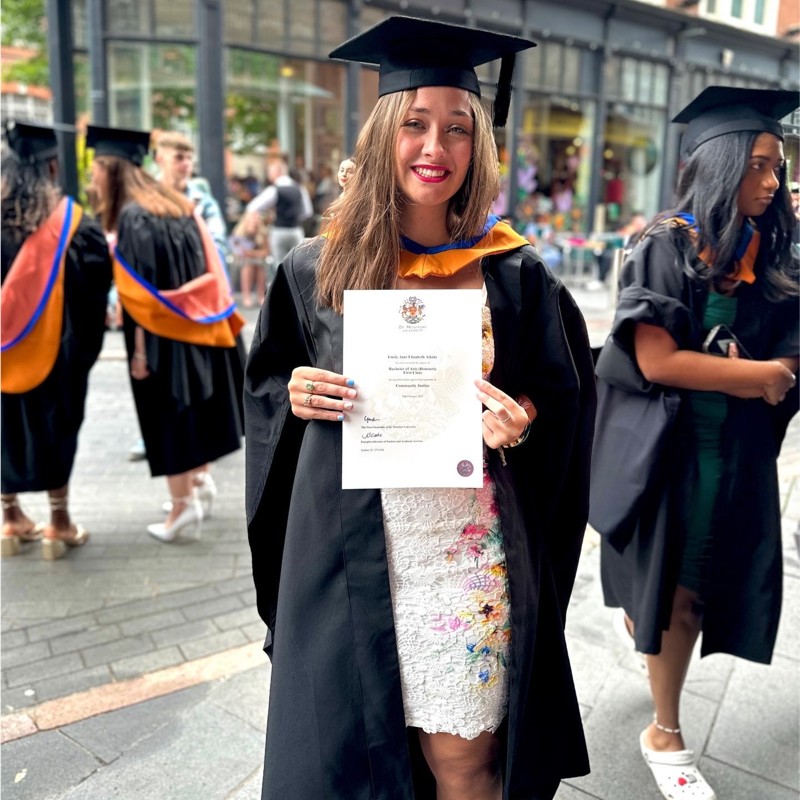
Emily Atkins
Current Employer/Organisation Name
Probation Service
What have you been doing since leaving Exeter, and what are you doing now?
Since leaving Exeter University, I gained a job at HMP Exeter in the resettlement team, helping those leaving prison with various areas such as accommodation, finance, employment and many other areas. After this, I gained a role as a Probation Service Officer in a Court team, and then undertook a Professional Qualification in Probation Practice (PQiP), gaining another degree-equivalent qualification and qualifying as a Probation Officer.
Why did you choose this career? And what do you enjoy most about your work?
I have always been interested in crime and criminology, and I enjoy helping others. I initially didn’t think I would work for the Probation Service and was adamant when I was in my prison role that I did not not want to be a Probation Officer, hearing stressful and negative things about the role. My career intention initially was to be a detective, and I did apply for the degree entry holder scheme at Devon and Cornwall Police on the first year this launched. I got to the final stage and didn’t pass, and I genuinely was gutted. I then applied for the Probation Service role and PQiP scheme and got accepted into this scheme much easier, and it felt more natural at the assessment centre. I’m glad things worked out how they did.
Please tell us if you were a member of any societies, groups or sports clubs?
I played for the Badminton Club for a time.
What did you enjoy most about your programme and what was the biggest highlight?
I liked the variety of modules; my favourite was the forensic science module where we had to analyse fictional and non-fictional crime scenes as part of the assessment process.
The biggest highlight for me was the fact I was local and so could undertake my studies whilst in the comfort of my own city where I had grown up. I could still see my friends and family which was lovely.
What did you most enjoy about studying here?
Being local and the variety of topics I was able to study. The campus is huge and beautiful.
Why did you choose to study at Exeter?
I lived and still do live local and at the time it was considered a good University for the subjects I wanted to study. And I know it still is a prestigious University.
What skills and experiences have been most useful for your career?
My writing skills from essays has helped a lot as I write formal reports for the Court; I achieved a First in my PQiP which I don’t think I would have if it hadn’t been for my recent University experience and knowledge.
My knowledge of criminology and social issues has helped me gain more of an understanding of the people that I work with, but equally working with these people and gaining experiencing on the job counts for so much too.
What advice would you give to a current student who wishes to pursue your career?
Gain experience in helping others even if it’s a volunteer role, particularly to work with those who are from disadvantaged backgrounds. Remember to always have humanity, be open and honest where possible and stand your ground.
What are your plans for the future?
To progress in my current role. I would like to be a manager one day. There is also a criminology degree scheme for managers within the Prison and Probation Service which I’m really interested in and would like to apply for one day.