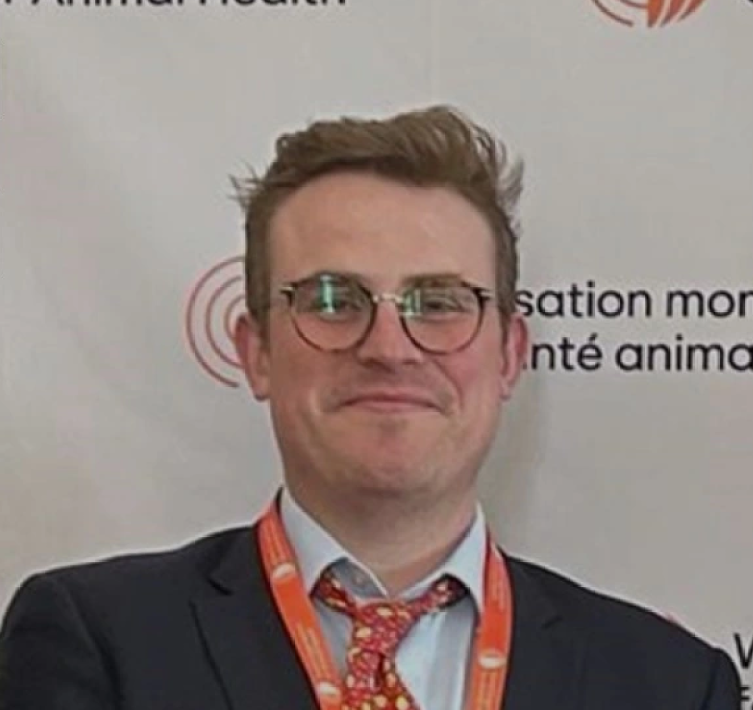
Jamie McFadzean
Current Employer/Organisation Name
Department for Environment, Food and Rural Affairs
What have you been doing since leaving Exeter, and what are you doing now?
I have worked across Government on EU-Exit disease control impacts, the Avian influenza outbreak, Antimicrobial resistance risks, and UK zoonosis control strategy. I also completing a postgraduate diploma in international policymaking at King’s College London, supported by the UK Government. I now lead on zoonotic disease policy within the Department for Environment, Food and Rural Affairs. This is an interesting area to work in because it sits at the complex centre of where scientific evidence meets political and economic realities. We undertake projects to answer specific gaps in our understanding and use this research to improve the knowledge-base of policy decisions. COVID-19 has greatly advanced public and political appreciation for the role of robust science in effective disease control policies.
Why did you choose this career? And what do you enjoy most about your work?
I always wanted to work in biological sciences, but increasingly realised my greatest satisfaction was in applying research findings outside of the lab into policy. The translation of experimental results into practical benefits for animals, humans and the environment is a powerful process to be part of. There are few jobs where teams of scientists, veterinarians, policymakers, economists, statisticians and lawyers work as closely and effectively towards a shared goal. A career in public service, should be just that and provide a true service to the public. Throughout my career I have been driven by that desire to meaningfully contribute to the public good.
What did you enjoy most about your programme and what was the biggest highlight?
I undertook a transdisciplinary PhD at Rothamsted Research & University of Exeter, on pathogen transfer in global agriculture. This enabled me to make use of the world class facilities, different research groups and engage with the student cohort at Exeter, while benefitting from extensive collaborations between institutes. My research included several international partners and I undertook extended periods working abroad across East Africa and Mexico, this was undoubtedly the most professionally and personally fulfilling experience.
What did you most enjoy about studying here?
There are few global centres of research that so successfully combine city and countryside access that Exeter does. The city is abuzz with students when the university is in session and with beautiful Dartmoor & the coasts in easy reach, you really got the best of both worlds.
Why did you choose to study at Exeter?
World-class reputation and unrivalled location.
What skills and experiences have been most useful for your career?
Balancing collaboration and critical thinking was very important skill developed during my PhD. The ability to work effectively as part of a diverse team while still being able to challenge prevailing thinking when needed, translates across careers.
What advice would you give to a current student who wishes to pursue your career?
Seek out as many diverse opportunities as you can, especially early in your career. I’ve followed what interests me and benefitted from good & bad experiences, all of which informed the direction I took. More than ever, scientists need to be able to influence across disciplines and take the lead in solving the most challenging issues we face.
What are your plans for the future?
To continue to contribute to students, scientific societies and charities. I hope my work on committees and as a trustee means I continue to benefit from collaborating with motivated individuals supporting the industry and next generation.