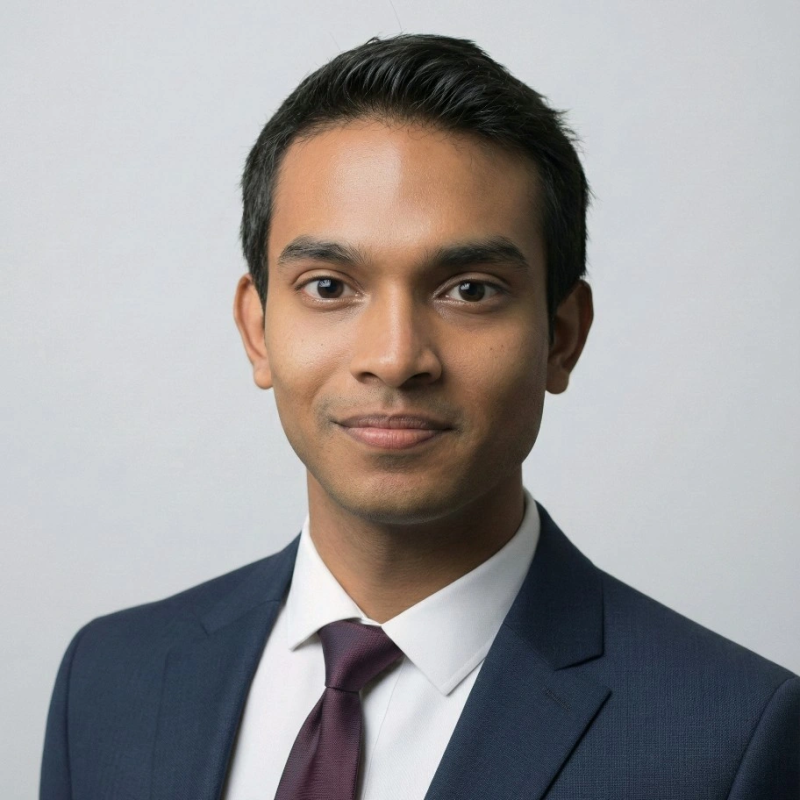
Rivu Basu
Current Employer/Organisation Name
UBS
What have you been doing since leaving Exeter, and what are you doing now?
Since graduating, I have navigated the financial sector, focusing on quantitative analysis and risk management. My journey began with roles in Market Risk, Treasury Mid-Office, and ALM, which gave me a holistic view of the banking ecosystem. Currently, I am an Associate Director at UBS, working within Model Risk Management. I specialize as an SME in complex and high-risk Treasury models, primarily Liquidity & Funding, ensuring they meet rigorous risk standards and G-SIB regulations.
Why did you choose this career? And what do you enjoy most about your work?
I chose this path to leverage my quantitative strengths in a practical, high-impact setting. I’ve always been drawn to the technical side of finance. What I enjoy most is the intellectual challenge of working with bespoke models. In my current role, I also get to explore the cutting edge of the industry, such as testing in-house AI tools and also acting as a prompt engineer for quantitative assistants, which keeps the work dynamic, fun and forward-looking.
Please tell us if you were a member of any societies, groups or sports clubs?
I was a member of the ASOC. These groups were crucial for building my early network and decompressing after exams (the various festival celebrations were my favorite!).
What did you enjoy most about your programme and what was the biggest highlight?
The biggest highlight was the practical structure of the modules. We would cover complex theory in afternoon lectures and then immediately apply those concepts during evening practical sessions. This was a game-changer for me as I fell more in love with the subject, and it guided me to visualize concepts tangibly. Having access to the Finance Lab and to that level of institutional data gave me a head start in building the hands-on experience I use today as a Quant. Beyond the academics, the collaborative energy across the campus is a standout memory, especially the Forum and the Library, which really felt like the heartbeat of the university. The Ram and various other such places were also a favourite to decompress.
What did you most enjoy about studying here?
It has to be the environment and the city. Streatham is widely considered one of the most beautiful campuses in the country for a reason. Being able to walk through the botanical grounds to clear my head before an exam was a luxury I didn’t appreciate enough at the time. I also loved the proximity to the city and the locals; spending sunny afternoons on Cathedral Green or heading down to The Quay gave me a perfect work-life balance. Being an international student, one always worries about being cut-off in a different culture than your own, but here, being a partly university town, people just know and respect that you are part of something pristine.
Why did you choose to study at Exeter?
To be completely honest, Exeter wasn’t very famous when (2015/16) and where I came from initially. However, once I started my research, the university’s credentials quickly stood out. The more I looked at the specific curriculum and where the alumni ended up, the more I was sold.
On a personal level, I have always lived in busy, bustling cities, so the idea of a prestigious, campus-based university a few hours from a major city offered a ‘fresh take’ with safety that I really needed. Combining that academic rigour with validation from family members living in the UK/EU about its popularity, I decided to take a leap of faith. It turned out to be the perfect balance of a high-performance environment and a great quality of life. I loved every second of it.
What skills and experiences have been most useful for your career?
Apart from the math/stat, the soft skills have been surprisingly vital. Transitioning from Treasury Mid-Office to a Quant role required immense adaptability and the ability to communicate complex ideas to non-quants. The diverse, collaborative environment with people from different disciplines for many modules at Exeter taught me how to bridge and leverage those gaps early on.
What advice would you give to a current student who wishes to pursue your career?
Don’t be afraid to start or apply. Many students think they need to land a very specific role on day one, but those foundational roles are where you actually learn how a bank ticks. You will be surprised that for many roles, as one of my previous boss said, “smart matters more than experience”. You can teach someone to do a job, but not to think (So ironically, do not think too much!)
My advice is to treat every role as a learning opportunity to build your technical grasp. Learn the regulations, master the models, but also work on your storytelling. Be honest about what you don’t know and then build from there, as being a quant SME is 50% technical ability and 50% explaining why the numbers matter to stakeholders who aren’t mathematicians.
What are your plans for the future?
Professionally, I just want to keep solving interesting puzzles in the Quant space without losing my sense of humor. The industry moves fast, so my main plan is to stay curious and keep up! On a personal note, I just want to ensure I’m always working on projects that challenge me intellectually, while saving enough time to enjoy life outside of spreadsheets. I definitely plan to make it back to campus, mostly to grab a drink at The Ram and see if the hills are actually as steep as I remember them, or if I was just unfit back then!