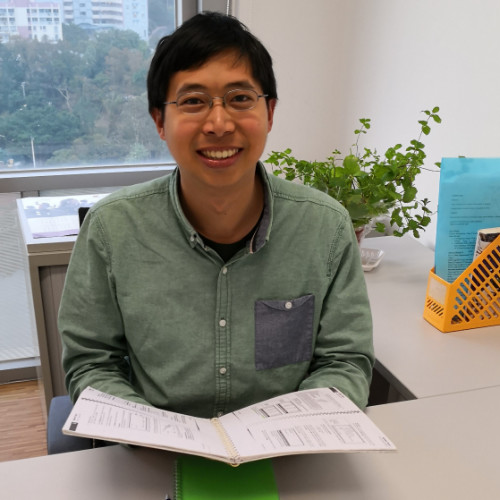
Felix Leung
Current Employer/Organisation Name
The Chinese University of Hong Kong
Can you give us an overview of what you have done since you completed your research degree?
Since completing my PhD in 2017, I have built a career bridging research, policy, and practice. I held postdoctoral positions at CUHK, then moved into applied roles at Hong Kong’s Forestry Department and The Nature Conservancy. I now lead climate education at CUHK, securing grants, publishing widely, and championing Nature-based Solutions through policy influence and conference organisation.
How did you become interested in the area you work in?
My interest grew organically from my ecology training at Imperial College, where I saw how human activity disrupts natural systems. During my PhD studying ozone impacts on crops, I realised science alone isn’t enough—solutions require translating research into policy. Establishing Hong Kong’s first Ozone Garden showed me the power of tangible, community-facing work. Working with The Nature Conservancy and advising government cemented my commitment to Nature-based Solutions that bridge science, policy, and practice.
How did you find opportunities in the area you work in and how did the recruitment process work?
I actively sought roles that bridged science and policy. After my postdoc, I applied for the Country Park Officer position at the Forestry Department through the government recruitment system—a standard application and interview process. For The Nature Conservancy, I was approached via my professional network, followed by multiple interviews focusing on my research-policy experience. My current CUHK role came through an internal application, leveraging my existing connections and track record at the university.
What does your current role involve?
My current role involves leading climate strategy and education across the university. I advise senior management on policies to achieve carbon neutrality and climate targets. I recruit and train student Climate Ambassadors, and serve as Co-Secretary of the Carbon Neutrality Working Group. I manage the Jockey Club Museum of Climate Change, leading a team of eight in operations and development. I organise conferences and workshops to promote the SDGs, apply for funding to support climate actions, and oversee climate research and public engagement activities.
What skills are involved in your work and how did your research degree help develop them?
My work demands a blend of scientific, strategic, and communication skills. I need technical expertise in ecosystem monitoring and data analysis, project management to lead teams and secure grants, and policy advocacy to engage government and stakeholders. My PhD was foundational—it taught me rigorous research design, quantitative modelling with JULES and Python, and critical thinking. But equally important, it trained me to translate complex science for diverse audiences, whether presenting at conferences or writing for the public. The Met Office collaboration also gave me experience working across disciplines and institutions.
What do you enjoy most about your role?
What I enjoy most is the impact at the intersection of science and society. I love seeing research translate into real-world change—whether it’s advising government on Nature-based Solutions, training students to become climate advocates, or securing funding for projects that build community resilience. The variety also energises me: one day I’m analysing blue carbon data, the next I’m speaking at a conference or mentoring young leaders. Every day feels meaningful.
What are the challenges in your role?
The biggest challenge is bridging the gap between scientific evidence and policy action. Despite strong data supporting Nature-based Solutions, decision-making often prioritises short-term economic or political considerations over long-term sustainability. Securing consistent funding is also demanding—grants are competitive and project-based, making long-term planning difficult. Additionally, coordinating across diverse stakeholders—government, NGOs, academics, local communities—requires patience and diplomacy, as interests and priorities often conflict. Balancing administrative duties with meaningful research and advocacy work is a constant juggle.
What has surprised you about your role?
What has surprised me most is how much time is spent on communication and stakeholder engagement rather than hands-on research. I expected to spend more time in the field or analysing data, but a significant part of my role involves negotiating priorities, building consensus, and translating science for non-experts. I’ve also been surprised by how receptive government and business leaders can be when you present evidence in the right way—it’s given me hope that change is possible.
Did you engage in any additional activities or roles (i.e. organising conferences, entering PGR showcase, being a PGR Rep etc.) during your research degree, and how did these help prepare you for a career beyond academia?
Yes, I actively engaged in activities beyond my core PhD research. I served as a Teaching Assistant for multiple undergraduate courses, which developed my communication and mentoring skills. I presented at major international conferences—including AGU, ICP Vegetation Task Force meetings, and the JULES Annual Science Meeting—which built my confidence in public speaking and networking. I also participated in the Grand Challenge programme at Exeter, facilitating interdisciplinary student projects. These experiences were invaluable: they taught me to translate complex science for diverse audiences, collaborate across disciplines, and manage projects—skills essential for my current policy-facing and leadership roles.
What skills and experiences have been most useful for your career?
The most useful skills have been quantitative modelling (JULES, Python, R) for analysing complex environmental data, and communication—distilling science for policymakers, the public, and students. My field experience with LiDAR, photosynthesis measurements, and bioindicator experiments gave me credibility with both scientists and practitioners. Equally valuable has been stakeholder engagement: working with government, NGOs, and local communities taught me how to build consensus and translate research into actionable policy recommendations. Grant-writing and project management have also been essential for securing funding and leading teams effectively.
What advice would you give to a current student who wishes to pursue your career?
My advice would be: stay curious beyond your narrow thesis topic. Build a diverse technical toolkit—modelling, fieldwork, data analysis—but also invest in communication and stakeholder engagement skills. Seek opportunities to collaborate across disciplines and with non-academic partners; my work with government and NGOs opened doors I didn’t expect. Publish and present widely, but also write for public audiences. Most importantly, be adaptable—my career path wasn’t linear. Embrace roles that bridge science and policy, and don’t be afraid to step outside academia to make a real-world impact.
What are your plans for the future?
My immediate goal is to secure a permanent research leadership position where I can continue advancing Nature-based Solutions in Hong Kong and the Greater Bay Area. I want to establish my own research group focused on wetland ecology, blue carbon, and climate resilience, while maintaining strong policy engagement. I also plan to expand my work on capacity-building—training the next generation of climate leaders and advocating for nature-positive development. Ultimately, I hope to influence regional policy so that Nature-based Solutions become the default approach to infrastructure and urban planning.