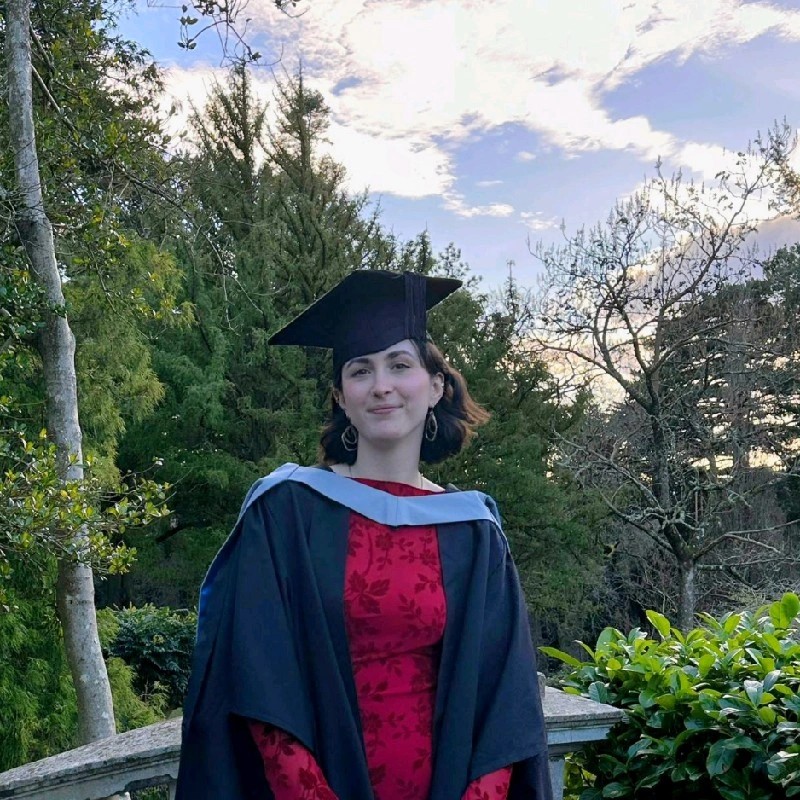
Lucia Mitchell
Current Employer/Organisation Name
Cheshire and Wirral Partnership Trust
What have you been doing since leaving Exeter, and what are you doing now?
I graduated in December 2024 from my MSCi Applied Psychological (Clinical). I then spent some time abroad for 2 months as a break before starting to apply for jobs. After a few months and interviews I landed my first full time position as an Assistant Psychologist within a Children and Young People’s Mental Health Team in Macclesfield where I have been since.
Why did you choose this career? And what do you enjoy most about your work?
I have studied psychology since I was 15, and it never left me bored or unfulfilled. I have always loved learning about and understanding human behaviour with a specific love for social and developmental psychology. During my Master’s year, I trained as a Psychological Wellbeing Practitioner (PWP), where I gained valuable experience supporting adults with mild to moderate mental health difficulties. This confirmed my desire to pursue a career focused on helping people navigate their mental health.
However, I also realised that I wanted to work within a more systemic and integrated framework, which led me to a role within a CYPMHS team. What I enjoy most about my work is the opportunity to support young people in understanding and managing their mental health. I find this work both deeply rewarding and intellectually stimulating, especially being part of a team that takes a holistic approach to care.
Please tell us if you were a member of any societies, groups or sports clubs?
I was part of the volleyball and the badminton societies during my first and second year of my undergrad degree.
What did you enjoy most about your programme and what was the biggest highlight?
What I enjoyed most about my programme was the wide range of topics within psychology that I was able to study. This gave me a broad understanding of the field and helped me identify the areas I was most passionate about, as well as those that were less suited to me.
The biggest highlight for me was the sense of community within my Master’s cohort. Moving from a large undergraduate group of around 400 students to a much smaller cohort of about 50 was a really positive experience. It allowed me to build stronger connections with my peers and created a more supportive and engaging learning environment.
What did you most enjoy about studying here?
I really value the people I met as well as what I’ve learnt from my course. Not only has studying at Exeter allowed me to get experience in a very competitive field, but I also met friends for life.
Why did you choose to study at Exeter?
I chose to study at Exeter for the unique course which I completed. Getting practical and relevant experience in psychology can be difficult, so the opportunity to do this in a supported and academic environment was very important for me. I also loved how Exeter was so close to nature and the sea, which really made my university experience!
What skills and experiences have been most useful for your career?
My Master’s year was particularly valuable in developing my therapeutic skills and deepening my understanding of how to apply psychological theory in practice. This experience was instrumental in helping me secure my current role, as it provided both the practical training and confidence needed to work in a clinical setting. More broadly, it also helped me clarify my career goals and the type of work I wanted to pursue within psychology.
What advice would you give to a current student who wishes to pursue your career?
It can be quite overwhelming, leaving university and moving to pursuing a career. We all move at our own pace, and it’s easy to get swept up in other people’s expectations.
I would encourage gaining a range of experiences to explore different client groups and work environments. Volunteering can be a great way to do this—there are many charities and organisations that welcome extra support, without needing huge amounts of time and these opportunities can be incredibly valuable in helping you find the right path for you.
What are your plans for the future?
My plans for the future are to continue gaining experience within the field of psychology and further develop my understanding of the areas in which I work most effectively. My long-term goal is to apply for a Doctorate in Clinical Psychology. In the meantime, I am focused on learning as much as I can in my current role so that I can provide the best possible support to the young people on my caseload.