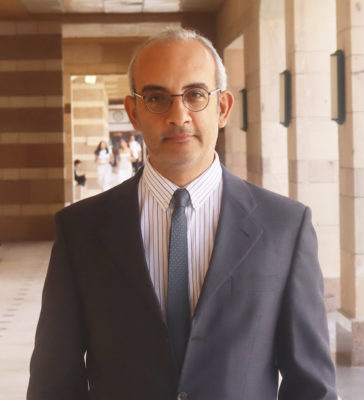
Mohamed Haj Yousef
Current Employer/Organisation Name
United Arab Emirates University
Can you give us an overview of what you have done since you completed your research degree?
I have focused primarily on research and scholarly publishing in the fields of time, cosmology, and fundamental physics. Building on my doctoral work on Ibn al-Arabi’s concept of time, I developed the Single Monad Model of the Cosmos and later the Duality of Time Theory, publishing several books and numerous peer-reviewed articles. My research explores the foundations of space-time, quantum mechanics, gravity, cosmology, and the relationship between physical and metaphysical reality, resulting in a sustained program of interdisciplinary scholarship spanning physics, philosophy, and cosmology.
How did you become interested in the area you work in?
My interest in this area began during my studies in physics, when I became fascinated by the nature of time and the foundations of reality. While studying modern physics, I was also exposed to philosophical and metaphysical discussions of time, particularly in the works of Ibn al-Arabi. I was intrigued by the similarities and differences between these perspectives and wanted to understand whether they could be reconciled within a coherent scientific framework. This curiosity led to my doctoral research and has continued to drive my work ever since, inspiring the development of the Single Monad Model and the Duality of Time Theory.
How did you find opportunities in the area you work in and how did the recruitment process work?
My interest in time and cosmology developed during my physics studies and led me to pursue a PhD at the University of Exeter. After completing my doctorate, I continued this research through publications, conferences, and collaborations. Academic opportunities came through my research record, professional network, and university positions, with recruitment typically involving applications, interviews, and evaluation of research and teaching credentials.
What does your current role involve?
In addition to teaching, I conduct research on the foundations of physics, focusing on time, space, and cosmology. My work involves developing theoretical models, publishing research papers and books, presenting findings at conferences, and collaborating across disciplines such as physics, philosophy, and the history of science.
What skills are involved in your work and how did your research degree help develop them?
My PhD helped me develop the skills needed to conduct independent research, critically evaluate existing theories, develop original ideas, and communicate them effectively. It also strengthened my academic writing, literature review, and interdisciplinary thinking skills, which remain essential to my research and publishing work.
What do you enjoy most about your role?
The opportunity to explore fundamental questions about the nature of reality and to contribute original ideas to our understanding of time, space, and the universe. I find great satisfaction in developing new theoretical frameworks, discovering connections between seemingly unrelated concepts, and seeing complex ideas gradually come together into a coherent picture.
What are the challenges in your role?
One of the main challenges is developing and defending new theoretical ideas that challenge established assumptions, while ensuring they remain mathematically rigorous, scientifically consistent, and open to critical evaluation by the research community.
What has surprised you about your role?
Connecting ideas across different disciplines. Some of the most interesting insights in my work have emerged from exploring links between physics, philosophy, cosmology, and the history of ideas rather than from a single field alone.
Did you engage in any additional activities or roles (i.e. organising conferences, entering PGR showcase, being a PGR Rep etc.) during your research degree, and how did these help prepare you for a career beyond academia?
My main focus was on research, writing, and presenting my work. These activities helped me develop valuable skills in independent thinking, project management, academic communication, and interdisciplinary collaboration.
What skills and experiences have been most useful for your career?
The most useful skills have been critical thinking, independent research, problem solving, academic writing, and the ability to communicate complex ideas clearly. Equally important have been perseverance, self-motivation, and interdisciplinary thinking, which have helped me develop original research and collaborate across different fields.
What advice would you give to a current student who wishes to pursue your career?
Follow your curiosity and choose research questions that genuinely interest you. Build strong analytical, writing, and communication skills, be open to interdisciplinary perspectives, and develop the persistence needed for long-term research. Most importantly, focus on producing high-quality work and sharing it through publications, presentations, and professional networks.
What are your plans for the future?
I plan to continue developing and refining the Single Monad Model and the Duality of Time Theory, while publishing research that explores the foundations of physics, cosmology, and the nature of time. I also hope to further engage with the wider scientific community through publications, collaborations, and conferences, and to contribute to a deeper understanding of the universe and its underlying principles.