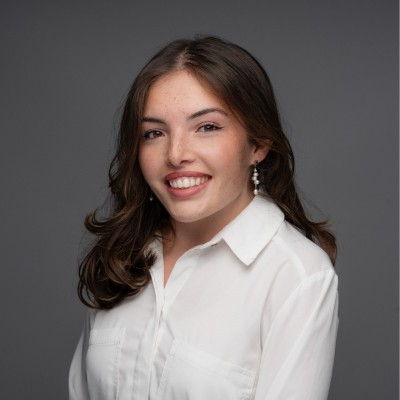
Tiffany McCabe
Current Employer/Organisation Name
Deloitte
What have you been doing since leaving Exeter, and what are you doing now?
I finished university in 2023, took a year out to travel and apply, and then started at Deloitte on the September 2024 graduate scheme. I’m an actuary within Audit and Assurance, I combine technical actuarial work with maths and auditing to ensure the numbers in Company’s pension accounts are accurate and reasonable.
Why did you choose this career? And what do you enjoy most about your work?
I chose this career because I’ve always been drawn to analytical work that’s both intellectually challenging and meaningful. I really enjoyed statistics and probability at university, and I liked that the actuarial exams build directly on that foundation, it felt like a natural continuation of what I’d studied, but applied in a real-world context.
I really enjoy developing and running models to derive financial assumption ranges that we can use to audit other firms’ financial assumptions. It’s really cool to see mathematical models play out against real market data and economic conditions.
Please tell us if you were a member of any societies, groups or sports clubs?
In my first year at Exeter, I was the first year mathematics representative on the University of Exeter Student-Staff Liaison Committee.
In my second year, I was Speaker Secretary and Chair of the Exeter Finance and Technology (FinTech) society.
In my third year, I was treasurer of the Exeter Finance and Technology (FinTech) society.
Throughout all three years, I was also a member of the Exeter Student Investment Fund (EXSIF) society.
What did you enjoy most about your programme and what was the biggest highlight?
I really enjoyed coding during my maths degree, applying theory to build models and solve problems.
The biggest highlight for me was the third-year group project. It was a really nice opportunity to work as a team and combine everyone’s strengths to build a model. It gave me a real sense of how mathematical skills are applied in a professional setting.
What did you most enjoy about studying here?
I really valued how approachable our lecturers were. Their office hours and maths clinic sessions made it easy to get support and truly understand complex concepts. Lecturers and tutors were always reachable, which meant I never felt alone or out of my depth. I would strongly encourage current students to make the most of these sessions, they are an excellent way to get help and feel supported.
Why did you choose to study at Exeter?
I chose Exeter because it has a strong reputation in mathematics, and I really liked the campus style.
What skills and experiences have been most useful for your career?
I use almost every aspect of my maths degree in my career, whether in my job or in my actuarial exams. I use statistics and probability when building models and assessing risk, calculus and integration when working on pricing and valuation models, and linear algebra for understanding more complex financial models. Even concepts like optimisation, stochastic processes, or understanding distributions are used regularly. Beyond the technical skills, the fundamental principles of mathematics logical reasoning, structured thinking, and problem-solving form the core of everything I do.
What advice would you give to a current student who wishes to pursue your career?
My advice would be to work hard on your degree first, maths is challenging and requires a lot of focus, so make sure you prioritise your studies. At the same time, it’s really valuable to get practical experience, whether that’s through internships, work experience, or joining financial societies. Balancing both can be tough, but your degree lays the foundation for everything else, so it should come first.
What are your plans for the future?
My main goal is to complete my exams and qualify as a Fellow Actuary of the Institute and Faculty of Actuaries. Alongside that, I plan to build my network within the company, learning from colleagues and exploring different areas within actuarial work so I can understand the field fully and decide where I want to develop my niche.