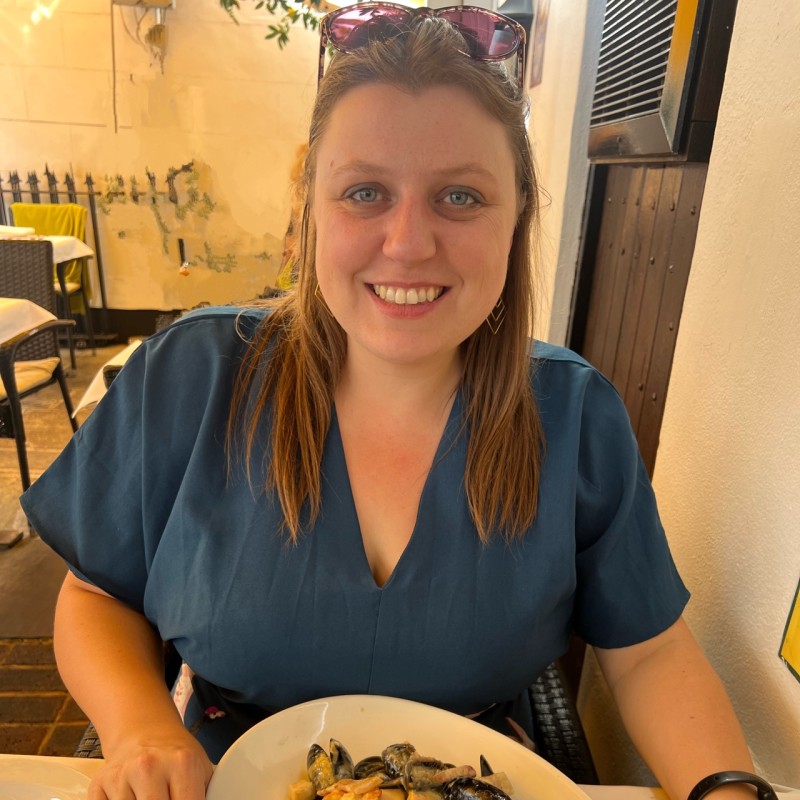
Harriet Bare
Current Employer/Organisation Name
Royal Veterinary College
Can you give us an overview of what you have done since you completed your research degree?
After completing my PhD, I did some temporary jobs before moving to Surrey to work as a research scientist at the Animal and Plant Health Agency (APHA). While at APHA, I stepped away from the bench into my first biosafety role, working across the Agency, but specialising in Pathology and Animal Sciences. After that I worked as the interim Biological Safety Officer (BSO) at the Francis Crick Institute before moving to the Royal Veterinary College to be their BSO.
How did you become interested in the area you work in?
I’ve always loved science and the continuous learning that comes with it. Biosafety gave me a way to stay connected to scientific research and new developments without being at the lab bench myself. In my role as a research scientist, I worked at CL3, which has far more stringent safety and training requirements and highlighted safety as a new career for me.
How did you find opportunities in the area you work in and how did the recruitment process work?
When recruiting for biosafety roles, employers often seek scientists with laboratory experience, scientists trained to work at CL3+ or those with practical expertise in GMOs and then offer to pay for you to undertake the necessary safety qualifications. That was the case for me. APHA was part of the Civil Service so the recruitment process hinged around assessment of behaviours, both at application and interview. For roles outside the Civil Service, I’ve submitted my CV and completed a personal statement or cover letter. All interviews have involved giving a presentation.
The biosafety world is quite small and friendly- often jobs are circulated through word of mouth or the mailing lists of professional bodies.
What does your current role involve?
Alongside being the BSO, I also advise on chemicals, radiation, lasers, animal byproducts, dangerous goods, DSE, manual handling…almost anything you might find in a lab, clinical or farm setting. The role is very varied so I never have the same day twice. On any given day, tasks involve inspections, audits, incident investigations, queries, drafting and reviewing documents, setting up new systems, liaising with regulators, delivering training, advising on new projects and providing feedback to various committees.
What skills are involved in your work and how did your research degree help develop them?
My role requires a variety of skills, particularly strong interpersonal skills, resilience, and the ability to analyse information quickly. A large part of the job involves influencing and persuading people to adopt safe ways of working, even when they may not initially agree with or understand the need for certain controls. Resilience is also important, as the role can involve managing challenging situations, competing priorities, and high workloads.
Another key skill is being able to review complex information, identify the most important points, and communicate them clearly to different audiences. Working in a scientific environment also requires a good understanding of the research and laboratory activities being undertaken so that I can provide practical and informed advice.
My PhD helped develop many of these skills. It taught me how to critically assess large amounts of information, summarise complex findings, and present them clearly through reports and presentations. It also strengthened my problem-solving abilities, resilience and ability to work independently.
What do you enjoy most about your role?
The variety – every day I am confronted with a new query or challenge.
What are the challenges in your role?
Part of my role is influencing and engaging stakeholders to embrace and adopt changes to improve safety, even when changes may be perceived as challenging or inconvenient – so often people can be challenges!
Resourcing is often a challenge as well. All of the safety teams I’ve worked in have been understaffed at some point and recruiting into H&S roles can be difficult because it’s quite a specialised field.
What has surprised you about your role?
How varied it is. The image that people associate with H&S is people walking around in hard hats with a clipboard with tick sheets and this couldn’t be further from the truth.
Also, how many safety people love Lego!
What skills and experiences have been most useful for your career?
Previously having worked in a research laboratory helps me build creditability with stakeholders and understand the challenges they’re facing – it helps me work with them to develop practicable solutions.
What advice would you give to a current student who wishes to pursue your career?
Get involved in health and safety in your area- nothing more powerful than to learn about how it works in practice. Be curious about why things are done in a particular way.
What are your plans for the future?
To continue to develop my technical expertise to achieve Chartered Membership status of one of the safety professional bodies and to complete all the swims on my wild swimming challenge map.