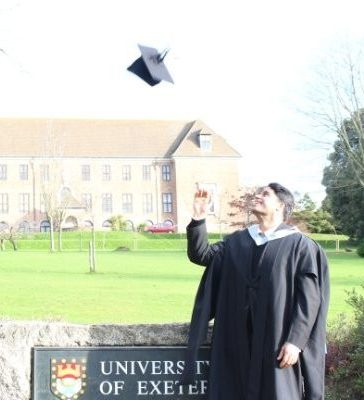
Rhianna Sookhy
Current Employer/Organisation Name
The Health Foundation
What have you been doing since leaving Exeter, and what are you doing now?
Since leaving Exeter, I went on to study for a Master of Public Health at Imperial College London. As part of the course, I completed my dissertation with the Hackney Public Health team, where I researched inequalities in endometriosis care pathways. This experience strengthened my interest in reducing health inequalities and using data to improve health outcomes.
Following my master’s degree, I joined The Health Foundation’s Graduate Trainee Programme. The programme consisted of two six-month placements within the organisation. My first placement was in the Improvement Analytics Unit, where I supported analysis and evaluation projects. My second placement was with the Healthy Lives team, where I worked on analysis relating to the wider determinants of health.
Although I left the programme slightly early, I did so to apply for a permanent Data Analyst position that became available internally. I was fortunate to secure the role, and I continue to work at The Health Foundation, using data and evidence to support research and policy work aimed at improving health and reducing inequalities.
Why did you choose this career? And what do you enjoy most about your work?
I chose this career because it combines my interest in public health with the analytical skills I developed during my Mathematics degree at Exeter. I particularly enjoyed statistics and using data to understand real-world problems, so working in a role where I can apply those skills to health and policy felt like a natural fit.
What I enjoy most is the variety of the work. I get exposure to a wide range of health topics and research areas, which keeps things interesting, and no two projects are quite the same. I’ve also enjoyed working alongside people from different professional and academic backgrounds and learning from their expertise. The Health Foundation has been very supportive of learning and development, giving me opportunities to build new skills, work across different teams and gain experience in areas I might not otherwise have been exposed to.
Please tell us if you were a member of any societies, groups or sports clubs?
I was part of the Netball club (I was Charity Secretary in my final year) and also part of Maths Society.
What did you enjoy most about your programme and what was the biggest highlight?
I enjoyed the mix of theoretical and applied mathematics. Some of my favourite modules were linear algebra and mathematical biology and ecology, as they showed how mathematical concepts can be used to understand and model real-world problems. Looking back now, it’s interesting to see how many of the foundations from my degree underpin things we use every day, whether that’s statistics in my current role or areas such as cryptography and network analysis.
The biggest highlight was being a Mathematics Student Co-Researcher. I worked on a project exploring the interdependence of mathematics modules across the University and the wider Russell Group, which contributed to an ongoing publication. It was a great opportunity to get involved in research and see a different side of academia. Outside of academics, I also met some of my closest friends through the course, many of whom I am still close to today.
What did you most enjoy about studying here?
What I enjoyed most about studying at Exeter was the balance it offered. I really enjoyed my degree, but there was also so much more to university life outside of academics. Netball was a huge part of my time at Exeter and gave me some of my best memories, as well as friendships that have lasted long after graduating. I loved the campus, and Exeter felt like the perfect size, big enough that there was always something going on, but small enough to feel familiar. Being close to the beach was also a huge bonus, and some of my favourite memories are from third term at the beach or running from Exeter to the beach. Looking back, it was the combination of my course, sport and the people I met that made my time at Exeter so enjoyable.
Why did you choose to study at Exeter?
I chose Exeter because the Mathematics degree offered a good balance of theoretical and applied topics and gave me the flexibility to explore different areas that interested me. I was also able to take optional modules in areas such as data science and economics, which provided a great foundation in coding and analytical skills that I still use in my career today. The green campus was another big factor for me, along with the wide variety of sports clubs and excellent facilities on offer. Overall, it felt like a place where I could get the most out of both my studies and the wider university experience, which was important to me when choosing where to apply.
What skills and experiences have been most useful for your career?
My degree gave me a strong foundation in analytical thinking and problem-solving, which has been useful throughout my career so far. More than anything, it taught me how to approach unfamiliar problems and learn new skills without feeling intimidated. Since graduating, I’ve worked with a range of analytical methods, from descriptive statistics and coding in R to regression analysis, evaluation methods and causal inference. While the specific techniques have changed, the ability to think critically, break down complex problems and interpret data has remained constant. The coding and statistical skills I developed at Exeter also gave me a head start when working with large health datasets and carrying out analysis in my current role.
What advice would you give to a current student who wishes to pursue your career?
I’d encourage students to get involved in as many different opportunities as possible and to keep an open mind. I didn’t know exactly what I wanted to do when I left Exeter, but I followed the areas I found interesting, took opportunities to learn new skills and gained experience wherever I could. Looking back, having a broad range of experiences helped me understand what I enjoyed and what I wanted from a career.
If you’re interested in health policy or analytics, I’d also recommend keeping up to date with current health issues and exploring publicly available datasets. There are lots of opportunities to use real-world data to investigate topics that interest you, and doing small projects can be a great way to build experience and develop your skills.
What are your plans for the future?
For now, my focus is on continuing to learn and develop within the health policy and analytics field. There is still so much for me to learn, and I feel like I’ve only scratched the surface of the range of topics and methods used in this area. I’m particularly interested in work that explores health inequalities and how evidence can be used to inform policy. Longer term, I’m looking forward to seeing where those interests take me as I continue to gain experience and develop my career.