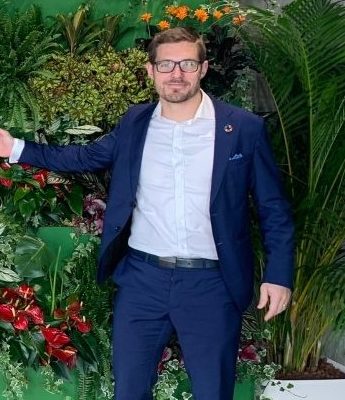
Thomas Holland
Current Employer/Organisation Name
Airbus
What have you been doing since leaving Exeter, and what are you doing now?
I have been working full time in the space industry, primarily on UK Secure Comms. Prior to my current role I worked as a Spacecraft Controller, a shift based role monitoring and operating our fleet of geostationary communications satellites.
Why did you choose this career? And what do you enjoy most about your work?
I have always been passionate about all things space, which nudged me in the direction of studying Physics over Computer Science when faced with the choice. Watching SpaceX testing its early iteration of its Falcon launch system when I was a teenager cemented what I already thought, that being able to contribute to space missions would be an incredible thing to aim for. Plus, who doesn’t dream of being an astronaut growing up?
What I enjoy most is having freedom to create, develop, and improve data analysis tools that I and my team feel would help us, conducting investigations into spacecraft anomalies that require outside-the-box problem solving, and the constant opportunities to learn and develop my skills.
Please tell us if you were a member of any societies, groups or sports clubs?
I was of course a member of PhySoc, but highlights of my time at Exeter often came through music societies. I was a member of ExTunes, playing drums for Exeter University Big Band, and some of my best memories of university come from playing gigs and competing in Battle of the Big Bands, which fostered an incredible camaraderie that I still maintain with some members to this day nearly a decade later.
What did you enjoy most about your programme and what was the biggest highlight?
I always enjoyed labs, in my case Astro labs. Quite often we would be analysing data taken from images of distant star clusters or the surface of the sun, which always felt pretty cool when you take a step back. In particular, my final project was in radio astronomy, where my lab partner and I took radio measurements across the galactic plane using the Physics building’s radio telescope and used the data to construct a top-down rendering of some of the Milky Way.
What did you most enjoy about studying here?
Exeter was such a fantastic university to attend, I’m not sure I could pick a single thing. Beautiful campus, high quality academics, a myriad of extra curricular opportunities, and so many lovely people who will be friends for life.
Why did you choose to study at Exeter?
I had the opportunity to attend a pre-university Physics course while I was in sixth form, so I had already stayed on campus for a weekend prior to beginning the decision making process. When Exeter was part of my final decision, I think simply having been there already made a difference! I’d been able to get a sense for what it would be like to live there more than during visits to other universities, and I could readily see myself being happy there.
What skills and experiences have been most useful for your career?
Problem-solving as a skill developed extensively during my degree, and I’ve found it to be so important in industry. On top of that, collaboration with other for coding projects has noticeable influence from working with lab partners, and general people- and social-skills from extra-curricular societies have made a huge difference, in particular my confidence built from music performance.
What advice would you give to a current student who wishes to pursue your career?
As the UK space industry grows, there have been more and more ways to provide opportunities for early careers. Airbus offer internships, grad schemes, and recently have added degree apprenticeships, and my team has always had an intern and now a degree apprentice helping us and learning from us to develop industry applicable skills and connections.
Opportunities often come from abroad as well, in my area people can often come from or go to Darmstadt and Toulouse.
Finally, don’t underestimate the value of extracurricular skills and experience, as they help to develop different aspects of skills from academics. In my case, I can wonder where I’d be without the confidence I built performing for the university Big Band!
What are your plans for the future?
The next year or two will be busy in my team with upcoming major launches, which is an incredibly exciting prospect. I’ve also found recently my affinity for the more computing heavy aspects of my team’s responsibilities, and I am considering pursuing this further with additional training and responsibility, which could open more doors to me in the future either in the industry or outside it.