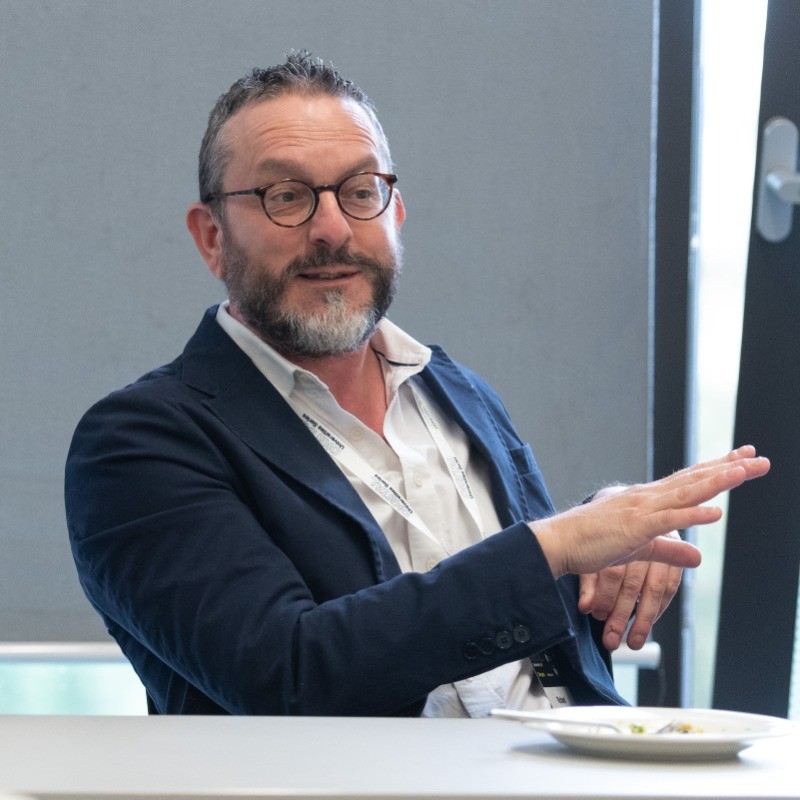
Richard Osborne
Current Employer/Organisation Name
UCL
Can you give us an overview of what you have done since you completed your research degree?
I trained as a secondary school science teacher and worked in the field for a few years. I then used my doctoral research to develop tools & techniques to create an EdTech consultancy business, again working with secondary schools in the UK. The Covid pandemic put paid to that business, but it led to me taking up my current role at UCL, which I’ve been doing ever since.
How did you become interested in the area you work in?
I’ve always had an interest in technology and at the same time I’ve long been fascinated by how we become who we are, what it means to be human. Whilst originally I was focused more on psychology that has increasingly become a focus on education as how we learn (in every context, both formal and informal) is fundamental to how we become who we are. That naturally led to combining the two passions into work in the educational technology field.
How did you find opportunities in the area you work in and how did the recruitment process work?
Jobs.ac.uk mostly. Recruitment directly run by UCL, as they are such a large organisation they are very well organised on that front.
What does your current role involve?
As Faculty Learning Technology Lead (FLTL) my role is to advise academic colleagues on how digital technologies can be used effectively within teaching and learning, to liaise with Digital Education, Arena and other departments across UCL to ensure colleagues are aware of centrally provided services, and to ensure local needs are understood and integrated appropriately into central planning.
What skills are involved in your work and how did your research degree help develop them?
The key things that have stood out in terms of my research degree are the rigour and the deep understanding of the nuances of my specialist field. As I work primarily with academic colleagues my credibility is the key to successful working relationships and that credibility in part comes from the rigour of my approach; being evidence based, sensitive to context, aware of evaluative pitfalls, etc. Similarly, having spent many years researching and working in my specialist field there is very little I do not know about and therefore cannot advise on, so I can provide a very comprehensive service in my role.
What do you enjoy most about your role?
Variability, the ability to apply expert knowledge, depth of work (as I usually create and run specialist projects to address specific issues in a SMART fashion), working with global experts, flexibility of working arrangements (I work from home in Devon even though I work for a London University).
What are the challenges in your role?
Building and maintaining effective working relationships at a distance. Prioritising competing tasks and objectives. Negotiating political tensions.
What has surprised you about your role?
Freedom to tackle the challenges as I see fit.
Did you engage in any additional activities or roles (i.e. organising conferences, entering PGR showcase, being a PGR Rep etc.) during your research degree, and how did these help prepare you for a career beyond academia?
I was a part-time student and was already working full-time in a similar role to the one I am working in now, so I had lots of practical experience already.
What skills and experiences have been most useful for your career?
How to work successfully with others is probably the most important, critically how to lead in a ‘matrix’ environment, and how to influence and lead without necessarily having authority. Many other skills have been useful, e.g. project management, how to carry out research, ethical clearance, presenting, report writing, etc., but people skills top the list.
What advice would you give to a current student who wishes to pursue your career?
Work out where you want to be long term, think about what success would look like quite a few years down the line. It’s a relatively new field to work in and I think it can be easy to get bogged down and lose direction, to find yourself pushed into work which you might find unrewarding. You need to be clear what you want to achieve and over what timescales.
What are your plans for the future?
Get a promotion, build a team, mentor the next generation of people who want to work in my field and ensure it gets the appreciation and respect that it deserves.